
“Elections are the heart of democracy. If elections are defective, the entire democratic system is at risk.” — Former President Jimmy Carter & Former Secretary of State James Baker
For nearly a decade, Americans have heard a steady refrain from Democratic leaders: “Trump is a threat to democracy.” From Nancy Pelosi to Chuck Schumer to the progressive wing of the party, the message has been repeated endlessly.
But this raises a more fundamental question: Is democracy at risk if our elections themselves are vulnerable?
Across the country, the answer depends heavily on where you live. The Heritage Foundation—one of the nation’s leading election‑integrity watchdogs—publishes an annual Election Integrity Scorecard evaluating how well each state protects secure and fair elections.
The results are stark:
- The 10 lowest‑scoring states are all blue states, with California ranking last at 20/100.
- The 10 highest‑scoring states are all red states, led by Tennessee at 91/100.
But Heritage is not alone. Multiple non‑profit organizations have documented widespread problems in voter‑registration systems and election administration:
- The Government Accountability Institute found that in 2017, 15,000 individuals across 21 states were registered at prohibited, non‑residential addresses.
- The Public Interest Legal Foundation identified 34,000 registrations at commercial addresses and 43,760 individuals registered more than once in the same state, many of whom voted twice in the 2016 election using mail‑in or absentee ballots.
These are not isolated issues. In the recent Los Angeles mayoral primary, a large share of late‑arriving mail‑in ballots traced back to Skid Row, where many individuals have no permanent address. Fox 11 News interviewed several who said they were approached daily by “signature gatherers” offering cash to sign forms under names that were not their own—and in some cases, to vote for incumbent Mayor Karen Bass.
Legal and political analyst Will Chamberlain has summarized California’s vulnerabilities with a simple equation: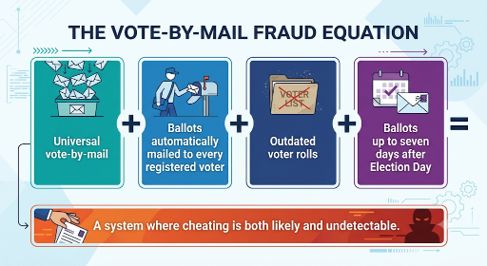 Even bipartisan leaders have warned about these risks. In 2005, former President Jimmy Carter (a Democrat) and former Secretary of State James Baker (a Republican) co‑chaired the Commission on Federal Election Reform. Their conclusion was blunt:
“If elections are defective, the entire democratic system is at risk.”
History offers its own cautionary tales. In the infamous 1948 Senate race, Lyndon Johnson won by fewer than 100 votes after mysterious ballot boxes appeared in Texas—an episode thoroughly documented by historian Robert Caro in Means of Ascent.
Fast‑forward to today: the recent failure of the SAVE Act in the Senate—despite passing the House—does not inspire confidence heading into the 2026 mid‑terms. The bill simply required proof of citizenship to vote. While the Constitution already limits voting to citizens, many states lack the safeguards necessary to enforce that requirement. This is precisely why Heritage and other organizations are pushing for transparency and reform.
So, what can we reasonably presume?
We can presume that many states are operating election systems vulnerable to fraud—by design or by neglect. And if citizens want secure, transparent, and fair elections, they must engage.
Start by checking your state’s election‑integrity score. If you don’t like what you see:
- Contact your state legislators.
- Connect with national organizations working on election integrity.
- Consider partnering with Heritage Action, which deploys trained activists to accompany citizens in meetings with state and federal representatives. Their experience is clear: local voices carry the most weight.
Be that voice. Be that clout. Let’s safeguard our democratic system and each do our part to protect the integrity of our Republic—state by state.